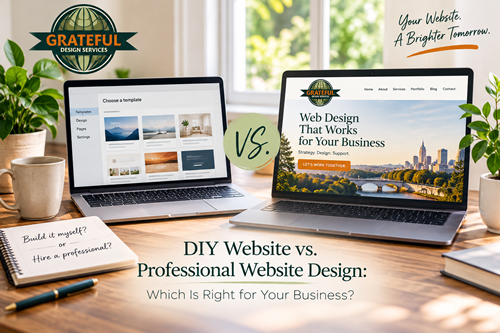
DIY Website vs. Professional Website
Which Is Right for Your Business?
Building a website has never been easier. DIY website builders promise that with a template, a few clicks, and some drag-and-drop tools, almost anyone can create a website.
And technically, that’s true. You can build a website yourself.
But building a website and building an effective business website are two very different things.
A professional website isn’t simply a collection of attractive pages. It needs to communicate your value, guide visitors toward action, work properly across devices, support search visibility, address accessibility, perform reliably, and grow with your business.
The biggest difference between a DIY website and professional website design is not simply how the website looks. It is the strategy, knowledge, and experience behind it.
DIY platforms give you the tools. A professional web designer knows how to use those tools as part of a larger strategy designed around your business.
DIY Website vs. Professional Website Design
at a Glance
| DIY WEBSITE | PROFESSIONAL WEBSITE DESIGN |
|---|---|
| Lower initial cost | Higher initial investment |
| Typically starts with a pre-built template | Designed around your business, audience, and goals |
| Business owner handles setup | Designer handles technical setup and development |
| SEO requires additional knowledge and work | SEO can be incorporated into the website structure |
| Owner handles updates and troubleshooting | Professional support can be available |
| Built primarily to get a basic site online | Built to support business and marketing goals |
| Requires your time to learn and manage | Allows you to focus more time on your business |
The difference becomes especially important when your website is more than an online brochure. If potential customers use your website to find you, evaluate your business, compare you with competitors, or decide whether to contact you, how that website is built matters.
Why DIY Websites Often Seem Easier Than They Really Are
The appeal of a DIY website is understandable. The initial cost is lower, templates look polished in the demos, and the platforms are marketed as easy to use.
What isn’t always obvious is how many decisions are involved in creating an effective business website.
Which pages should you have? How should visitors move through them? What information should appear first? What keywords should you target? Are your headings structured properly? Are your images optimized? Does the website work well on mobile devices? Can search engines understand it? Are your forms working correctly? Is the site accessible? Are analytics set up properly?
Most business owners aren’t website designers, developers, SEO specialists, content strategists, and accessibility experts.
Nor should they have to become all of those things just to have an effective website.
That is where professional website design provides value that a template alone cannot.
A Template Is a Starting Point, Not a Strategy
DIY website platforms make design easier by providing pre-built layouts. But a template doesn’t know your business.
It doesn’t know who your customers are, what questions they have, why they should choose you, what information matters most to them, or what action you want them to take.
Professional website design starts with those questions.
Who is visiting your website? What are they looking for? What should they see first? How easily can they find your services? What questions need to be answered before they contact you? Where should calls to action appear?
A professionally designed website should intentionally guide visitors through your content instead of simply presenting information to them.
The goal isn’t just to make a website attractive. The goal is to create a website that communicates clearly and helps turn visitors into customers, clients, donors, members, or supporters.
Your Website Should Look Like Your Business
Templates are designed to work for thousands of different businesses, which is precisely why they can easily look generic.
Your business isn’t generic, and your website shouldn’t be either.
Colors, typography, photography, page layouts, messaging, navigation, and calls to action should work together to create a consistent identity.
This becomes especially important when a potential customer has several competing businesses open in different browser tabs.
What does your website communicate about your business in those first few seconds?
Professional website design allows the website to be built around your brand and your goals rather than trying to fit your business into a predetermined design.
SEO Goes Far Beyond Adding Keywords
This is one of the biggest areas where DIY website building can become complicated.
Search engine optimization involves much more than finding a few keywords and adding them to a page.
Page titles, headings, internal links, image optimization, mobile usability, site structure, page speed, metadata, content quality, and numerous technical considerations can all help search engines understand a website and its purpose.
Google recommends creating helpful, reliable, people-first content rather than content created primarily to manipulate search rankings.
Learn more from Google Search Central
A website can look beautiful to a visitor and still have problems behind the scenes that make it difficult for search engines to understand what the business offers.
The challenge for a DIY website owner is knowing what to look for in the first place.
SEO is most effective when it is considered throughout the website rather than treated as something to add after the site has already been built.
Mobile Design Is More Than Making Everything Smaller
A website should work well whether someone visits from a desktop computer, tablet, or phone.
That means much more than shrinking a desktop layout until it fits on a smaller screen.
Buttons need to be easy to use. Text needs to be readable. Navigation should make sense. Images need to display properly. Forms need to function correctly, and important information shouldn’t become buried or difficult to find.
Layouts that look great on a desktop computer can behave very differently on a phone.
Professional designers can test and adjust layouts across different screen sizes instead of simply assuming the website builder has handled everything automatically.
Accessibility Should Be Part of the Design Process
Website accessibility is another area that can easily be overlooked when building a website yourself.
Accessibility includes considerations such as alternative text for images, keyboard navigation, readable content, appropriate color contrast, clear page structure, and accessible forms.
The World Wide Web Consortium (W3C) develops the Web Content Accessibility Guidelines, commonly known as WCAG. These guidelines provide internationally recognized recommendations for making web content more accessible to people with disabilities.
Learn more about the Web Content Accessibility Guidelines
W3C also encourages organizations to consider accessibility throughout the development process rather than waiting until the end of a project.
Introduction to Web Accessibility
Accessibility isn’t simply another item to check off after a website is finished. When accessibility is considered as part of the design and development process, it can also contribute to a website that is easier for everyone to navigate, read, and use.
A Lot Is Happening Behind the Scenes
When you visit a website, you see pages, images, navigation, forms, and content.
You don’t see everything happening behind them.
Software updates, backups, security, redirects, analytics, integrations, database management, performance optimization, forms, spam protection, and troubleshooting are all part of maintaining a modern website.
And eventually, something will need attention.
A plugin may conflict with another piece of software. A form may stop sending notifications. An update may affect a page layout. A website may suddenly slow down.
With a DIY website, figuring out what happened and how to fix it usually falls on the business owner.
Professional website support means having someone who understands websites and knows where to begin when something goes wrong.
Your Website Should Be Able to Grow With Your Business
The website you need today may not be the website you need three years from now.
Businesses add services. Teams change. Marketing strategies evolve. Technology changes. Search behavior changes.
You may eventually want to add online scheduling, e-commerce, downloadable resources, email marketing integrations, videos, a blog, customer portals, online courses, or other functionality.
A professionally built website can take future growth into consideration from the beginning.
That can make it easier for your website to evolve along with your business rather than discovering later that you have outgrown what you originally built.
The Hidden Costs of DIY Website Design
The lower upfront price of a DIY website can make it seem like the less expensive option.
But the subscription price isn’t the only cost to consider.
There is the time spent learning the platform, researching SEO, troubleshooting problems, resizing and optimizing images, fixing mobile layouts, managing updates, creating content, and trying to determine why something isn’t working.
There can also be an opportunity cost.
What happens if potential customers can’t find your website in search?
What if they arrive but can’t quickly understand what you offer?
What if the website doesn’t look as professional as your business actually is?
What if the mobile experience is frustrating?
What if visitors aren’t being guided toward contacting you?
A website that saves money upfront but fails to effectively support the business can ultimately cost more than the initial savings.
So the real question isn’t simply:
“Can I build my own website?”
A better question is:
“What does my website need to accomplish for my business, and do I have the expertise and time to build it correctly?”
Professional Website Design Is About More Than the Design
One misconception about hiring a web designer is that you are primarily paying someone to make the website look better.
Design is certainly part of it, but professional website development goes much further.
You are also paying for experience.
A professional brings together strategy, design, technology, SEO, usability, content organization, accessibility considerations, mobile responsiveness, troubleshooting, and knowledge gained from building and maintaining websites over time.
That experience helps a designer recognize issues a business owner may never realize they should be looking for.
Professional website design isn’t about paying someone to do something you could technically do yourself.
It is about having someone who knows what needs to be done, why it matters, and how all the pieces need to work together.
Frequently Asked Questions About DIY and Professional Website Design
Can a DIY website rank on Google?
Yes. Simply using a DIY website platform doesn’t prevent a website from appearing in Google search results.
However, ranking involves much more than the platform itself. Content quality, website structure, technical SEO, mobile usability, performance, internal linking, competition, and other factors can all play a role.
The challenge isn’t whether a DIY website can rank. The challenge is whether the person building it understands how to properly optimize the website while also running a business.
Is it worth paying someone to build a website?
If your website is important to how customers find you, evaluate your business, contact you, or purchase your products and services, professional website design can be a valuable business investment.
You aren’t simply paying for pages to be built. You are investing in the strategy, technical knowledge, design experience, and support behind those pages.
Isn’t a DIY website much cheaper?
The initial expense is lower.
However, it is worth considering the value of your own time and the potential cost of a website that doesn’t perform as effectively as it could.
If you spend dozens of hours learning software, troubleshooting problems, researching SEO, and correcting design issues, the true cost of DIY may be higher than the monthly platform fee suggests.
Can’t I just start with DIY and hire a professional later?
You can, and many businesses do.
However, depending on the platform and how the original website was constructed, moving to a professionally designed website later may require significant rebuilding rather than simply improving what is already there.
If you already know that your website will be an important marketing tool for your business, involving a professional earlier can help establish a stronger foundation from the beginning.
When should I hire a professional web designer?
If your website represents an established business or nonprofit, generates leads, supports sales, competes for search visibility, requires specialized functionality, or plays an important role in establishing your credibility, professional design becomes increasingly valuable.
It may also be time to call a professional when managing your website is taking time away from actually running your business.
Your Business Deserves More Than a Template
If you need a temporary online presence, personal project, or extremely basic website, a DIY website builder may be enough.
But when your website represents your business, the stakes are considerably higher.
Your website is working for your business 24 hours a day. For many potential customers, it will be their first experience with your company before they ever speak with you.
It should communicate the quality of your business, help people find what they need, establish credibility, support your marketing efforts, and encourage visitors to take the next step.
At Grateful Design Services, we provide professional website design and ongoing website support for businesses and nonprofit organizations in Sacramento, throughout California, and beyond.
We combine website design with ongoing maintenance, SEO and analytics, content development, accessibility considerations, and digital marketing support to help our clients build and maintain a stronger online presence.
DIY tools can help you build a website. A professional can help you build a website that works for your business.
Whether you need a completely new website or you’re wondering if you’ve outgrown the website you built yourself, we’re happy to talk about where your website is today and where you’d like it to go.

Laura Rider is the Founder, Lead Web Designer, Developer, and Project Manager at
Grateful Design Services
a Sacramento, California-based web design company helping small businesses and nonprofits create beautiful, accessible, and SEO-driven websites. Drawing from years of creative experience through her previous company, Cobalt Images, Laura combines design, strategy, and functionality to help clients grow online.